Matboard Bridge - structural design project
Design & Manufacturing · Coursework · 2021
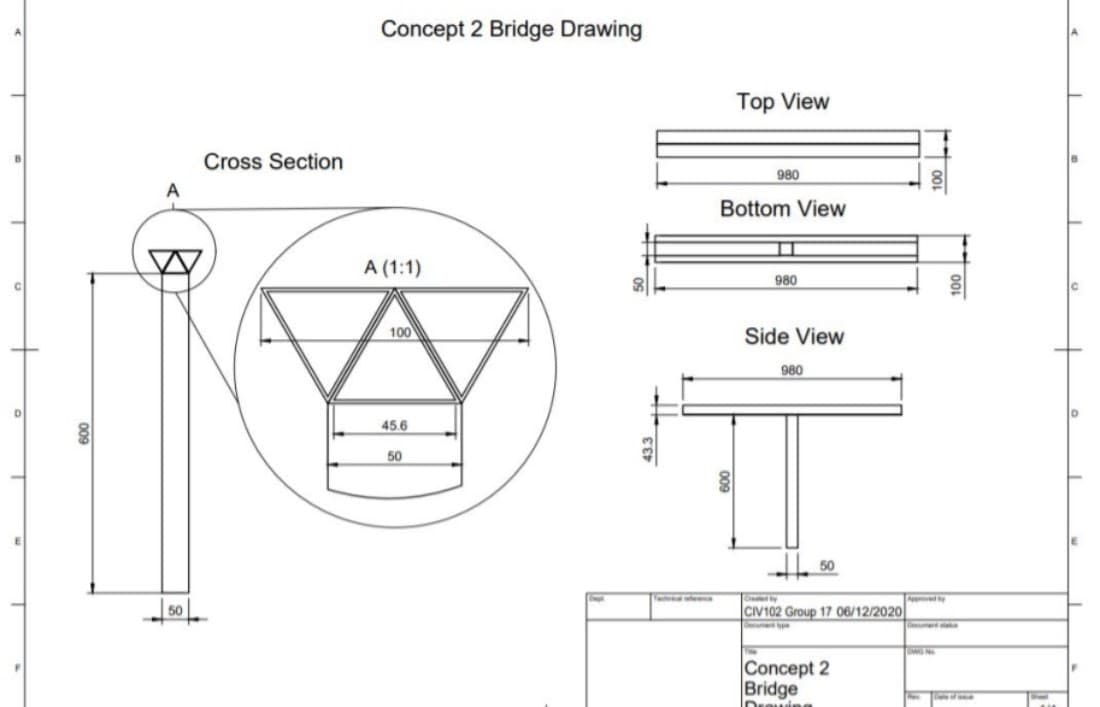
In this first-year design project, our team was challenged to span a wide valley using only sheets of matboard and glue. We developed and analyzed two bridge concepts, one supported only at the ends and one with an intermediate support, then justified our final design through calculations, simulation, and engineering drawings.
- Deliverables: two bridge concepts, structural calculations, CAD models, and drawings
- Focus: load capacity, failure modes, and material efficiency
- My role: structural analysis, CAD modelling, and simulation
Problem and design brief
The challenge was simple in theory but constrained in practice: design a bridge from matboard that could carry as much load as possible while meeting strict limits on geometry, material use, and construction method. One concept used a box-girder structure supported only at the ends, while the second introduced an intermediate support to change the internal force distribution.
Our team had to evaluate both concepts analytically before building anything. That meant identifying likely failure modes such as buckling, shear, and joint failure, then using those insights to compare how each design would behave under load.
Analysis and iteration
I focused on the structural calculations and CAD side of the project. Using beam theory and hand calculations, I estimated internal forces across different geometries and support conditions, then translated the stronger concepts into detailed Autodesk Fusion models.
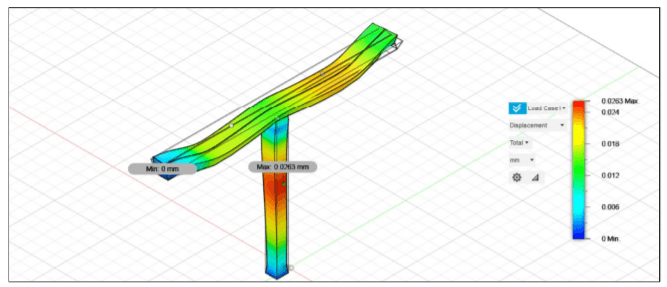
From there, I used simulation to compare stress distributions, refine dimensions, and identify areas where the structure might fail early. These iterations helped us improve stiffness and load-bearing capacity while keeping the bridge lightweight and buildable within the project constraints.
Outcome and what I learned
The final design balanced stiffness, manufacturability, and efficient material use. Our bridge met the course requirements and performed close to expectations in physical testing, which reinforced the value of connecting analysis, modelling, and fabrication.
This project was one of my earliest experiences seeing how hand calculations, CAD, and testing all support one another in the design process. It also helped me treat CAD as more than just drafting. It became a way to test assumptions, communicate design intent, and build something others could reliably evaluate and manufacture.
Tools and methods
- Hand calculations using beam theory and shear/moment analysis
- Autodesk Fusion for CAD modelling and layout
- Basic simulation to compare stress distributions
- Engineering drawings for fabrication
- Team design reviews and failure-mode analysis